Tuesday, 30 November 2021

Life Beyond The Physical Object


This poster explains the meaning of value-led conservation, breaking this term into easy-to-understand sections. Featuring a case study by the Pitt Rivers Museum that outlines the conservation process of Sacred Blackfoot Shirts. I have highlighted why the value-led conservation process is important to follow in the field of conservation.  


Wednesday, 24 November 2021

Issues in the conservation of performance art

This poster explores two key issues in the conservation of performance art: the idea of material authenticity and the notion of liminal space within the works of art. It investigates the effect of both problems, conveying how modern and contemporary performance art pieces subvert traditional modes of conservation.


Tuesday, 23 November 2021


Armed conflict poses a potentially devastating threat to precious human lives, but it destroys the cultural heritage of those human civilizations. Here we will consider 3 periods in which conservation professionals play a role in prevention, mitigation and rectification of these hazards to this heritage: Anticipation of Conflict, During Conflict and Post-Conflict.

Friday, 19 November 2021


Contemporary Art - Common Obstacles and Issues

This poster explores common obstacles present in conservation of contemporary artwork, by highlighting some of the techniques used, and how these can cause issues with conservation. It is important to understand these problems, to allow the field of conservation to continue to adapt and evolve alongside the ever-changing art world.


Conflict Conservation: An Ongoing Struggle, What More Can We Do?


Conserve From Disaster


This poster explores the work of heritage conservator in the aftermath of an unpredictable and uncontrollable natural disaster by selecting the Wenchuan earthquake, one of the worst earthquakes to have occurred in China's heritage concentrated lands. Post-disaster heritage conservation and reconstruction is not just the restoration and conservation of heritage buildings but a systemic project that involves the cooperation of many parties. In the midst of this, heritage conservator, as one of the parties, are bound to face multiple challenges.We will discuss three of the main challenges in this process.

Conservation through collaboration: Adding and preserving value by sharing decision-making with indigenous communities.


Participatory conservation is a methodology that seeks to involve non museum stakeholders in conservation decision making. Conservation professionals can collaborate directly with indigenous communities when looking to preserve objects originating from their cultures. This poster explores the benefits and challenges of this approach as well as two case studies. 


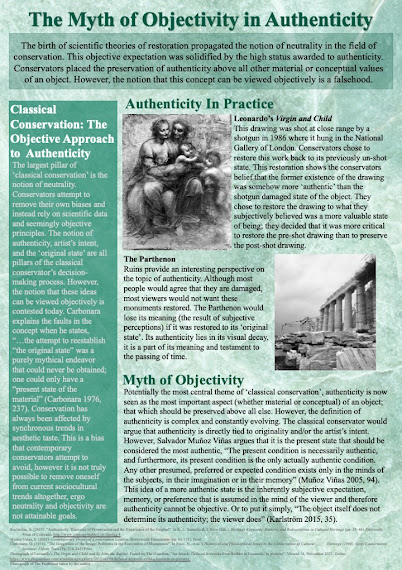
The Myth of Objectivity in Authenticity


This poster aims to illustrate the subjective nature of the idea of authenticity within the wider framework of 'classical conservation' and its focus on neutrality. By understanding that the notion of objective authenticity is an inherently flawed concept, conservators can evaluate objects and their values more truthfully and creatively. 


Minimal Intervention in Cultural Heritage and Contemporary Art Conservation


Minimal intervention is a common ethical core of conservation practice. Using case studies of a Māori Waka Taua and a Damien Hirst work, we can explore a reinterpretation of minimal intervention in two conservation disciplines.


This poster discusses how climate change affects cultural heritage. It briefly examines the new considerations conservators need to take into account, and how to mitigate the constant climate changes and possible threats they are posing to cultural heritage.  Conservators need to assess risk, prepare and coordinate communities, battle these changes and preserve heritage. 

Different Layers, Different Values and Meanings

By presenting a case study, the poster explores the values and meanings that a public monument may convey for multiple stakeholders within a particular context. It discusses how these diverse perspectives affect the decision-making process, stressing that conservation is never neutral but may favour certain views while undermining others.

Wednesday, 17 November 2021


In recent decades, street art has begun to occupy both public and traditional art spheres, like galleries and museums. Its dualities - illegal and legal, transient and permanent, free to be viewed or sold at art auction - challenge conservators and conservation decision-making.


With some assumptions about the ‘social good’ of heritage interventions under question, heritage professionals are adopting and adapting conflict-sensitive approaches commonly used by humanitarian/development actors. Such resources can help conservators better realise ethical and conflict-sensitive approaches to heritage interventions in fragile contexts and situate their actions within broader development interventions.


Wednesday, 7 April 2021

Celadon Lobed Pot with Lid: Statement of Significance

The celadon lobed pot with lid (Figure 1) was assessed against historic, aesthetic, research, and social significance. 

Figure 1: Celadon Lobed Pot with Lid


It was acquired in Nottingham, U.K. The previous owner was a private collector who purchased it from China and claimed it is a product of the late Qing. Although no marks can be found on it, historic archives indicated that a folk kiln in Sunkeng, Zhejiang Province might be its kiln during its dating period. 

Its bean green colour was developed at Longquan kiln during the Northern Song (960-1127) and became a classic colour since then. It was designed and decorated in the shape of melon which conveys an auspicious implication in Chinese culture that the family grows and prospers like spreading melon-vines (Geng, 1993). Although claimed to be gourd-shaped, its form should be described as ‘lobed’. The crackled glaze (Figure 2) is deemed as a decorative effect rather than a technical failure, which shows a good example of how Chinese-styled aesthetics and imagination are applied on celadon’s production. 

Figure 2: Fine Crackles on the Vessel’s Lid 


Its manufacturing kiln can be further investigated with involvement of local ceramic experts; described by the vendor as a brush pot, its form and size that are different from other known examples of brush pots (Figure 3) suggest other hypotheses of its function; the glaze material on the underside (Figure 4) is unusual and increases its research potential and rarity. 

Figure 3: Comparison of the Object with Typical Brush Pots (Source: China Guardian Auctions Co. Ltd., 2019)


Figure 4: A Diffuse Glaze Material on the Underside and A Close-Up 


Chinese celadon is often associated with a variety of cultural practices or activities of the user such as calligraphy, painting, and flower arrangement, reflecting the user’s cultural identity or expressing the wish of self-cultivation, which is different from the traditional European perspective that takes ceramics as ‘decorative arts or crafts with visual satisfaction but without expressing any meaning or emotion’ (Shubert, 1993). Celadon and its manufacturing technology represent Chinese intangible cultural legacies.


References:

Geng, B. C. (1993). Appraisal of Ming and Qing porcelain. Beijing: Forbidden City Publishing. 

Shubert, S. B. (1993). ‘The decorative arts: A problem in classification’, Art Documentation: Journal of the Art Libraries Society of North America, 12(2), pp.77-81. 


Esther 

Monday, 1 March 2021


This object is a soapstone vase. it is cool to the touch at room temperature and the stone exhibits a range of colours including reds, greens, brown and greys.  Soapstone mainly refers to talc-bearing ultramafic metamorphic rock which gives the stone a soapy texture.  Its hardness ranges between 1 and 2 ½ on the Mohs scale. A possible way to test  material would be to create an incision, if it is soapstone then even a fingernail can scratch it.   Technologies likely used to create this object would involve reductive carving, sanding and polishing. It is likely to have been carved by one artisan who would have created the design around the unique inclusions found within the stone.


Friday, 20 November 2020

Kintsugi: Aesthetic Value-led Conservation


Kintsugi is a traditional gold-joinery ceramic restoration technique. It restores the practicality and functionality of broken objects, while adding decorativeness. Influenced by the culture of Wabi sabi, Kintsugi stresses significance in the aesthetic value of objects. This poster presents the origin and cultural background of kintsugi, and its dialectical vision of authenticity.


Eva Hesse's Latex and Fibreglass Sculptures: A Case Study in Contemporary Conservation


Latex and fibreglass sculptures of pioneering artist Eva Hesse present a number of contemporary conservation challenges including rapidly degrading and fragile materials, conflicting commentary from the artist, arguments for and against refabrication, and the possibility of unstoppable destruction. 

No Object is an Island: the necessity for collaboration in Conservation Practice


Conservation is a specific discipline, but it does not work on its own. In order to successfully start the conservation process, participation in the decision-making process is important from the international level, to internal museum departments to smaller external interest groups.   

Preserving Moments: Challenges in the Conservation of Street Art


    Street art conservation is one of the more prominent and contentious topics in the field. This poster begins by briefly defining street art, framing it within the body of cultural heritage. Issues of legality, authenticity and practicality in its conservation are addressed. This is then highlighted through a case study of the recently ‘missing’ Bristol Banksy Gorilla.


Challenges between contemporary art and conservation work


Nowadays, the conservation of contemporary art becomes an important challenge. In this poster, the general introduction of contemporary art is given at first, and then the challenges occur during conservation. Finally, Damien Hurst's 'The Physical Impossibility of Death in the Mind of Someone Living 1991' is represented as case study.

My blog list