Saturday, 17 November 2012

Neutrality, Objectivity and reversibility: fact or fiction? By T K

Neutrality, Objectivity and reversibility: fact or fiction? By T K
Abstract: The present poster explores the concepts of neutrality, objectivity and reversibility. Although such long held tenets have guided conservation interventions since the mid-twentieth century, dynamic social changes are calling them in question.  In addition, their roles in decision making process in relation to the current approach of conservation are being thoroughly examined.
Target: Conservation students (Approximate Age: 18-23)

Conservation and sacred tradition by T Hudson


Conservation and sacred tradition by T Hudson


Abstract: In cases of in situ conservation of religious heritage, the original custodians are not only important stakeholders but can also be valuable resources for the conservation process. Conservators must approach such situations with a sense of openness to different value systems and the possibility for mutual education. Case studies demonstrate positive instances of preservation and continuity achieved through cooperation and communication.  
Target: Museum professionals, conservators, conservation students

Contemporary Art: Authenticity & Replicas by S Kavda


Contemporary Art: Authenticity & Replicas by S Kavda
Abstract: This poster uses case studies of conceptual art to introduce notions of authenticity and replicas  in eastern and western cultural contexts. It points out the need to alter conservation approaches towards contemporary artworks, as they contradict  some aspects of conservation ethics. The aim is to highlight that it may not be unethical to replicate contemporary works of art when materiality is not its central value.
Target: Professional art conservators, especially contemporary art conservators.

Balancing the intangible by E B


Balancing the intangible by E B is the first of a series of posters designed by students of the course Principles of Conservation to be posted here. Principles of Conservation is one of the core courses of the UCL-Q MSc in Conservation Studies, taught by R Peters in Doha.  We will be posting other posters here soon. Watch this space!  ffff
fffffffffffffffffffffffffffffffff

Abstract: The intent of this poster is to present the recent changes in methodology and perspective within the conservation profession. While classical conservation has tended to concern itself with the object and material components of an ethnographic object, the field is changing to accommodate interests in a collaborative and dynamic process with authority given to the living cultures from which the objects originated. Particular focus here is given to the living, intangible and sacred cultural heritage of North American Native and Indigenous peoples.
Target Audience: Museum visitors, with a specific emphasis toward those who might be considered amateur ethnographers as well as undergraduate students of museology and conservation.

The Maya: climate change and Spanish conquest

Two interesting articles about the Maya emerged recently. The first refers to research done by Archaeologists of the National Institute of Anthropology and History (INAH) whereby evidence indicates the Maya living in an ancient settlement of Mexico's east coast endured appallingly miserable lives during the Spanish conquest of the 16th century. 

"Found in the recently opened archaeological site of San Miguelito, in the middle of the hotel chain area of Quintana Roo, near Cancun, the human burials were excavated within 11 housing buildings dating to the Late Postclassic Mayan Period (1200 – 1550)... Archaeologists of the National Institute of Anthropology and History (INAH) estimate that at least 30 burials belong to infants between the ages of three and six. The majority suffered from hunger and most likely died of related diseases." 


The second item refers to the research published on Science magazine and discusses the influence of climate change in the rise and fall of the Maya. See excerpt from the NYT below:


"The early classic Maya period — about A.D. 450 to 660 — “was remarkably wet,” said an author of the study, Douglas Kennett, a geo-archaeologist at Penn State. “There was a proliferation of population, an increase in agriculture and a rise in divine kings that became prominent leaders.” ... But then things dried up. The researchers compared the climate record with an existing “war index” — a log of hostile events based on how often certain keywords occurred in Maya inscriptions on stone monuments — and found a strong correlation between drought and warfare between cities. ... “About A.D. 660, you get indications of some social stress that goes up in tandem with this drying period” ... Maya cities were linked, but each operated with its own autonomous political structure. When resources were strained, the groups may have turned against one another. Over several hundred years, “the social fabric was eventually destabilized,” Dr. Kennett said. Most Maya cities collapsed between A.D. 800 and 900."


See more info about this on News Discovery, the NYT and Science 

Did this feather headdress belong to Moctezuma II?

This headdress is believed to be one of the most fragile objects in the Museum of Ethnology, Vienna. A group of Austrian-Mexican experts spent two years studying, analyzing and conserving it as part 
of a project organized by the Instituto Nacional de Antropología e Historia (INAH) in Mexico and the Kunsthistorisches Museum Wien. 
The outcomes are said to be published soon - let's hope very soon! 


"The project focused on anthropological, historical, iconographic and conservation questions. Materials, technique and older restorations of the feather head-dress were analyzed. Its present flat appearance dates back to the restoration carried out in 1878 that had erroneously identified the feather head-dress as a standard. This resulted in the object’s loss of the three-dimensional shape it had had as a head-dress. At the time over 370 new small metal plates, feathers and skins of kingfishers were incorporated. The feather head-dress comprises a wealth of different materials: organic ones such as feathers, plant fibres, wood, leather, paper and textiles, but also non-organic materials such as gold and gilded brass. The friction and abrasions caused by these materials and the artifact’s age have compromised its state of preservation and complicated its conservation. The aging process of the organic materials has resulted in irreparable, brittle and fragile areas. Although the object has been stabilized with careful interventions and preventive conservation measures its original condition cannot be recreated. However, after careful cleaning and various conservation measures the feather head-dress can now be put on public display again after an absence of many years."

More Information: http://artdaily.com/index.asp?int_sec=2&int_new=58955#.UKX6oobaFvV[/url]
Copyright © artdaily.orghttp://artdaily.com/index.asp?int_sec=2&int_new=58955#.UKX6oobaFvV

Wednesday, 7 November 2012

"Insinuendo: Murder in the Museum", a conservation mystery by Miriam Clavir

If you are a fan of Miriam Clavir's work you will probably be interested to know that she has now published a novel, in her own words, a conservation mystery: Insinuendo: Murder in the Museum

Clavir says the novel is a character-driven m
ystery more in the genre of a cozy than a thriller; it has tension (and humour) but won't give a reader nightmares. Here’s a brief description she sent us:

Insinuendo: Murder in the Museum 

Berry Cates has undergone a “radical lifectomy”, remaking her life at fifty-three, newly single and in a new career. In her first job as anartifacts conservator at the Museum of Anthropology, she is faced with answering why a visiting expert died from arsenic housed in her lab.
Determined to prove false these accusations against her and the conservation lab, Berry instead gets into deeper trouble. Her sleuthing uncovers museum staff casting illicit bronzes and blackmail being delivered via a Roman curse tablet. The conservation of a painting reveals evidence of curatorial fraud. Arsenic was an old preservation method used against insects and now Aboriginal people are accusing the museum of poisoning their heritage regalia with pesticides.
Only when Berry realizes she has been asking the wrong questions does she stop sliding down the snake of museum deceit. Dial M for Museum.
ISBN: 978-1-897411-38-4; trade paperback; publisher: Bayeux Arts http://www.bayeux.com/
(Distribution: Literary Press Group of Canada/LitDistCo; University of Chicago Press Distribution)

Clavir thanks MOA for generously allowing the museum to be the site of this fictional murder and mayhem.

Thanks for letting us know, Miriam, I can't wait to read it!

Friday, 12 October 2012

Heritage Without Borders Albania Conservation Summer School 2012


Once you have lived such an interesting, fulfilling and funny experience the will to share it with as many people as possible comes naturally. To tell the world what a good time you had, what wonderful people you met and how much you learnt. This is what has been happening to me since I came back from Tirana, Albania, about a week ago.

Stepping back a bit, I may start by introducing Heritage Without Borders, the UCL-based charity that is at the base of the Albania Conservation Summer School 2012 project. The organisation has been founded by UCL alumni willing to contribute to preservation of cultural heritage in areas of the world where more problems are present. In my opinion the most exciting part of their vision is that they focus on working with local heritage professionals. The aim is to build up their confidence and connect them with local communities, international conservators and organisations, to create national and international networks for the preservation of cultural heritage.
The cobbled street of Berat, UNESCO World Heritage Site

I've always considered the possibility of working in an international, multicultural environment one of the most fascinating aspects of conservation so I took the opportunity and applied as a volunteer for HWB. I was lucky to be chosen to participate in their latest project in the Balkans.


The Albania Conservation Summer School 2012, funded by Headley Trust, was held in Tirana between the 24th and the 28th September 2012, in collaboration with Cultural Heritage without Borders (similar name, but different organisation!). It was a one-week training course in basic preventive conservation for heritage students and professionals.
The main topics addressed during the course were principles of preventive conservation, understanding and monitoring the museum environments (lights, relative humidity, pests, pollutants, etc.), correct handling, packaging and organisation of storerooms.  The schedule was full of lectures, discussions, practical activities and visits. 


Sokol Cunga, archivist at the State Central Archive of Tirana shows us a precious manuscript
Participants carry out a condition assessment
Recording the objects from the Institute of Archaeology, Tirana

An important aim of the project was also to create an occasion for people working in different countries and institutions to meet each other, building contacts and a local network of interest in conservation of cultural heritage. About 25 people from the southern Balkans participated in the course: Albania, Kosovo, Macedonia. Many of them had a great deal of experience in conservation, and we tried to engage them in sharing their expertise as much as possible. Indeed, what excited me the most about the course was the great opportunity to learn from each other. 
Participants were involved in giving presentations about their work, assisting during practical activities, discussing about different treatment methods, as well as effective engaging strategies in museums. After a couple of days to get to know each other, a great atmosphere was created among us. Everyone was willing to share problems faced in his/her own institutions, as well as participating in finding possible solutions. The most interesting aspect of being in such an international environment was to realise how the risks that threaten cultural heritage are often the same in different parts of the world. Complaints about inadequate storage areas were shared by Megan, from Wales, Goran, from Macedonia, Stefanie from Ireland, and then Albania, Kosovo, UK, etc. Realising that we all face the same problems was a powerful incentive to sharing and cooperating to find a solution.

Measuring light levels in the National Museum, Tirana


Fortunately the social aspect was not neglected either! We had chances to get to know each other, chatting about non-conservation-related topics (sometimes!) and having fun. I personally learnt how to say Cheers! in at least three different languages!

Me and the other volunteers worked really hard and made our best to make the experience as fruitful as possible. 
Stefanie shows how to use a swirling hygrometer

The volunteer team was composed by Stefanie White, Ma (hons) Ma B.Sc. Conservator, Ireland, our team leader;
Azra Becevic Sarenkapa, MA in Conservation of Historic Objects, Senior Textile Conservator at National Museum of Bosnia and Herzegovina;
Megan de Silva, BSc, Objects Conservator: Monmouthshire Museums Service, Wales;
and me, Francesca Guiducci, MSc Conservation for Archaeology and Museums, University College London.
Azra is delivering a lecture about conservation of textiles
For me it was a great opportunity to build my experience and confidence in working in an international environment, in engaging with people, in delivering lectures and activities. 
I really want to thank everyone that participated in the project for contributing to creating such as wonderful experience. For me, it has been a fantastic opportunity to meet inspiring people, and it really gave me a new boost of enthusiasm for what I am doing.

Falemnderit!

 Francesca                      

If you are interested in reading more about Albania Conservation Summer School 2012, visit the project blog. We have been blogging daily about the course, with more info about people and activities:


If you are interested in Heritage Without Borders, its history and future projects, visit the website:


Monday, 8 October 2012

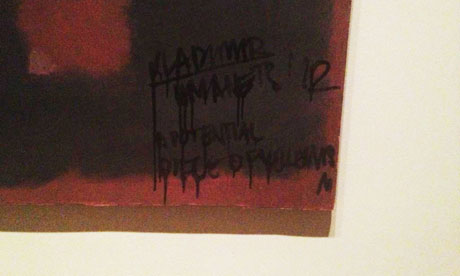
Rothko defaced at Tate Modern

By now you must have heard about the defacing of a Rothko at Tate Modern yesterday. How sad. Even sadder is to have to read that the vandal claims to be an artist. There is more, he also claims to have added to the value of the painting, and cites Marcel Duchamp.

Sincerely, Mr Vandal, your arrogance is sickening.  You are far too mediocre to enhance the value of a Rothko, don't try again!


See more details on The Guardian

My blog list